Original 39-record edition. Read the current edition.
UK SDR & BDR Salary Benchmark 2026
Original analysis of advertised UK SDR and BDR compensation, with separate comparisons by location, seniority, enterprise targeting and base-to-variable structure.
 By Elric Legloire · Research snapshot: November 21, 2026 · 12 min read
Q4 2026 research snapshot, assembled through November 21, 2026. We reviewed 69 records and retained 39 supported, comparable advertisements. Publication dates vary; this selected sample measures advertised packages and does not measure employee earnings.
UK SDR median OTE · n=39
£65,000
London SDR median · n=32
£68,250
London enterprise median · n=10
£82,500
Key findings · 39 supported advertisements
Executive summary
UK SDR & BDR Salary Benchmark 2026 · Research snapshot, November 21, 2026
Across 39 supported UK SDR and BDR advertisements, the median advertised on-target earnings (OTE) was £65,000. For 32 London positions the median was £68,250, and for 10 London positions explicitly focused on enterprise accounts it was £82,500. These are descriptive medians of different, overlapping groups rather than comparable estimates of an enterprise pay premium.
- Seniority and account focus produce different observed distributions. In the sample, UK enterprise-focused roles had an £82,500 median OTE (n=10); all 10 were in London. These positions overlap with geographic and seniority cohorts; differences are not controlled salary premiums.
- Base and variable pay are not interchangeable. Among 28 packages disclosing both figures, the median base share of OTE was 66.7%. The median disclosed base salary was £41,250. Advertisements do not establish realised earnings or quota attainment.
- Hiring budgets require more than salary observations. The accompanying scenario models recruiting, ramp and operating costs separately from salary data; its assumptions are illustrative, not market findings.
Research limits: This is a selected, London-heavy sample, not a representative survey of UK SDR pay. Twenty-two included postings have independently verified primary publication dates between August 21 and November 21, 2026. Twelve observations use dated secondary sources, identified in the data. For salary ranges we used the midpoint of advertised OTE, not realised earnings.
Source data and planning model
The underlying advertisements, calculated statistics and an editable hiring model are available without an email gate.
What is the UK SDR salary benchmark for 2026?
| Group | Advertisements | Median advertised OTE | Mean advertised OTE | Median disclosed base* |
|---|---|---|---|---|
| All UK SDR / BDR roles | 39 | £65,000 | £68,897 | £41,250 |
| London SDR / BDR roles | 32 | £68,250 | £72,094 | £44,000 |
| UK enterprise-focused SDR / BDR | 10 | £82,500 | £86,850 | £50,000 |
| London enterprise-focused SDR / BDR | 10 | £82,500 | £86,850 | £50,000 |
| Named UK locations outside London | 5 | £50,000 | £52,900 | £32,500 |
| UK-remote-eligible roles | 2 | £57,750 | £57,750 | £43,000 |
Median base salaries use only listings with an explicit base amount: 28 UK-wide, 21 London, seven UK enterprise-focused and seven London enterprise-focused. The enterprise rows overlap with the geographic totals and must not be added together. Median base and median OTE are computed from their respective available observations, so they do not describe one typical individual offer. UK-remote-eligible roles are grouped separately from named cities.
The interquartile range for all 39 advertised OTE midpoints was £58,250–£80,000. The London enterprise median (£82,500) sits above that upper quartile, although those positions form part of the UK sample. For hiring comparisons, the cohort matters at least as much as the overall median: enterprise roles, graduate roles and generalist SDR positions are not interchangeable. These descriptive comparisons do not isolate the effect of seniority or account segment on pay.
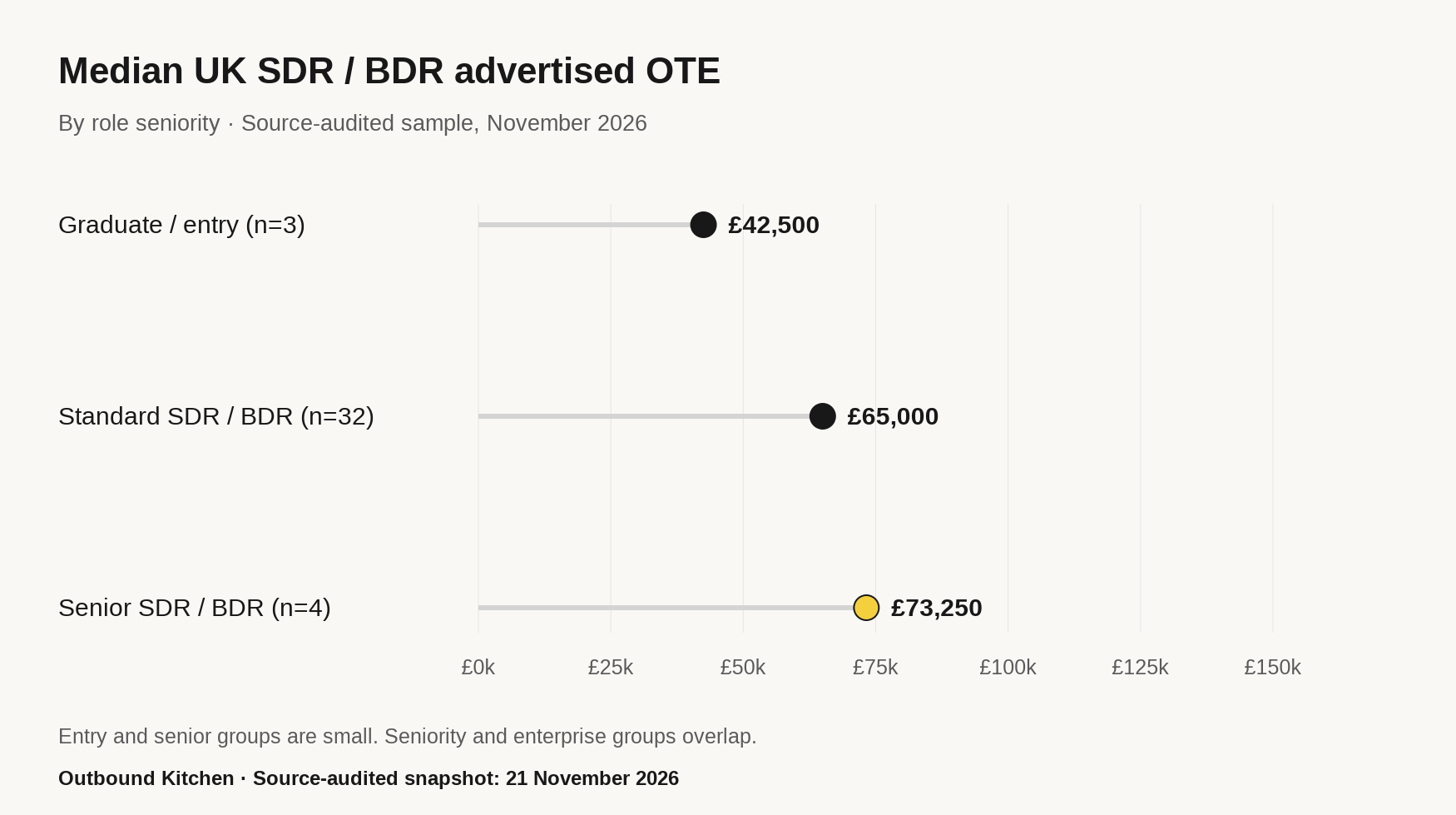
How does UK SDR pay differ by seniority?
| Advertised seniority | Advertisements | Median advertised OTE | Median disclosed base* |
|---|---|---|---|
| Graduate / trainee / entry-level | 3 | £42,500 | £30,000 |
| Standard SDR / BDR | 32 | £65,000 | £42,000 |
| Senior SDR / BDR | 4 | £73,250 | £45,000 |
The entry-level and senior medians describe small groups of advertisements and should not be treated as stable population estimates.
The observed medians increase with the seniority of the advertised role. The difference between entry-level and senior listings is £30,750, although it cannot be interpreted as a controlled experience premium: employers, sales motions and job requirements differ across these groups.
Seniority was classified separately from account focus. A senior enterprise BDR, for example, is counted in the senior cohort and the enterprise cohort, but only once in the overall UK sample. This makes the subgroup tables useful for different questions without creating additional observations.
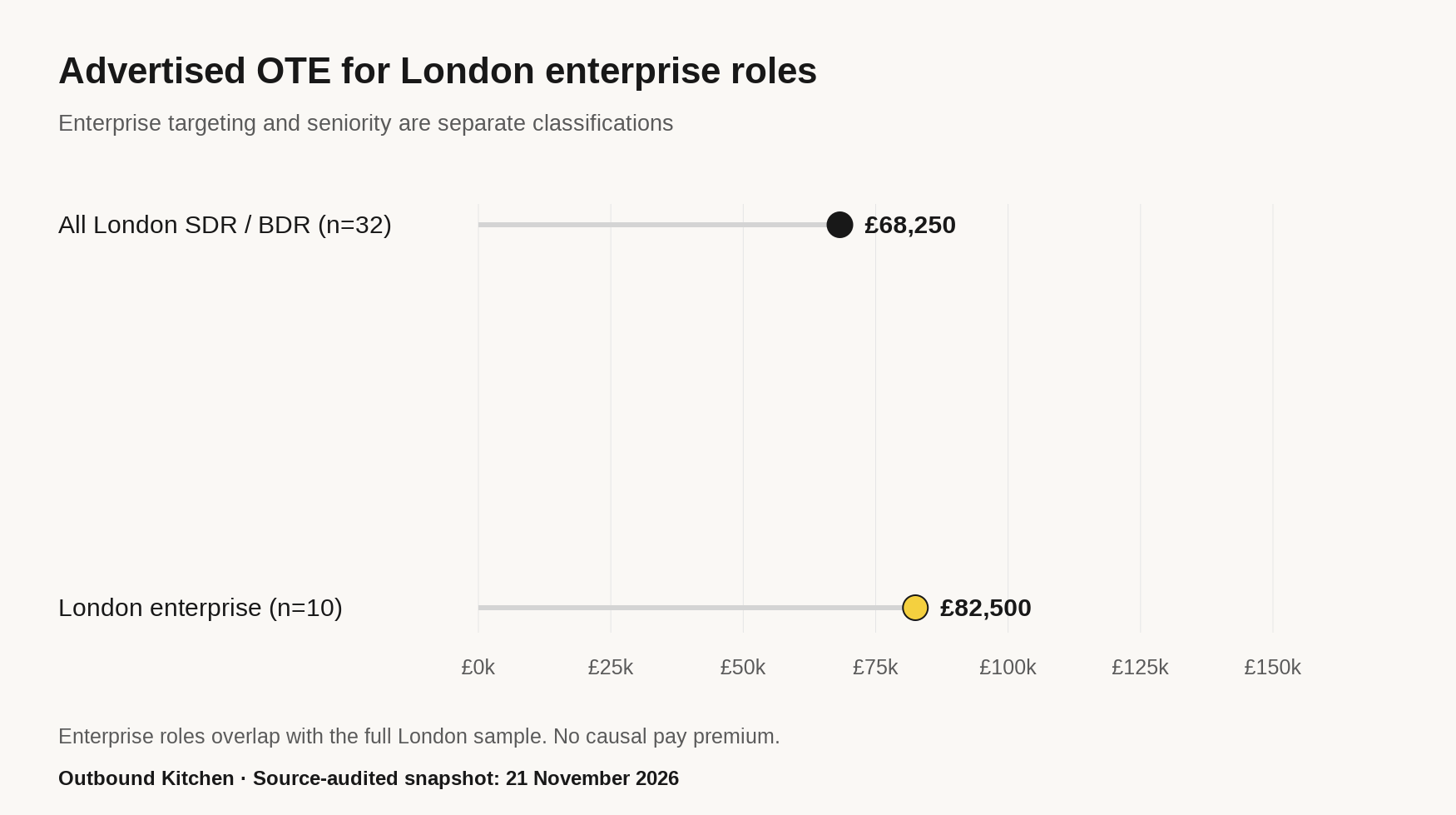
How much are London enterprise SDRs paid?
Among the 10 enterprise-focused London listings, the median advertised OTE was £82,500. The 25th and 75th percentiles were £74,375 and £90,000, respectively. Seven listings contained a usable base figure; their median disclosed base salary was £50,000.
The following examples illustrate the variation in advertised packages. These links document job advertisements observed during the research, not necessarily vacancies that remain open today.
| Role | Advertised base | Advertised OTE | Source |
|---|---|---|---|
| Timberseed: Enterprise SDR, London | £45,000 | £80,000 | Recruiter listing |
| ClaimSorted: Enterprise SDR, London | Not disclosed | £70,000–£100,000 | Company listing |
| Timberseed: Senior SDR, Series C SaaS | £45,000 | £80,000 | Recruiter listing |
These examples describe packages recorded on 21 November 2026. They do not establish current vacancy availability. Timberseed advertises on behalf of unnamed employers. The source workbook records evidence dates, source status and verified archive links.
All 10 supported enterprise-focused advertisements in the UK sample were in London, with a median advertised OTE of £82,500. The data do not establish how much of the salary difference is caused by account size rather than seniority, employer mix or commission design. The practical comparison is between positions with similar responsibilities, not between two unadjusted population medians.
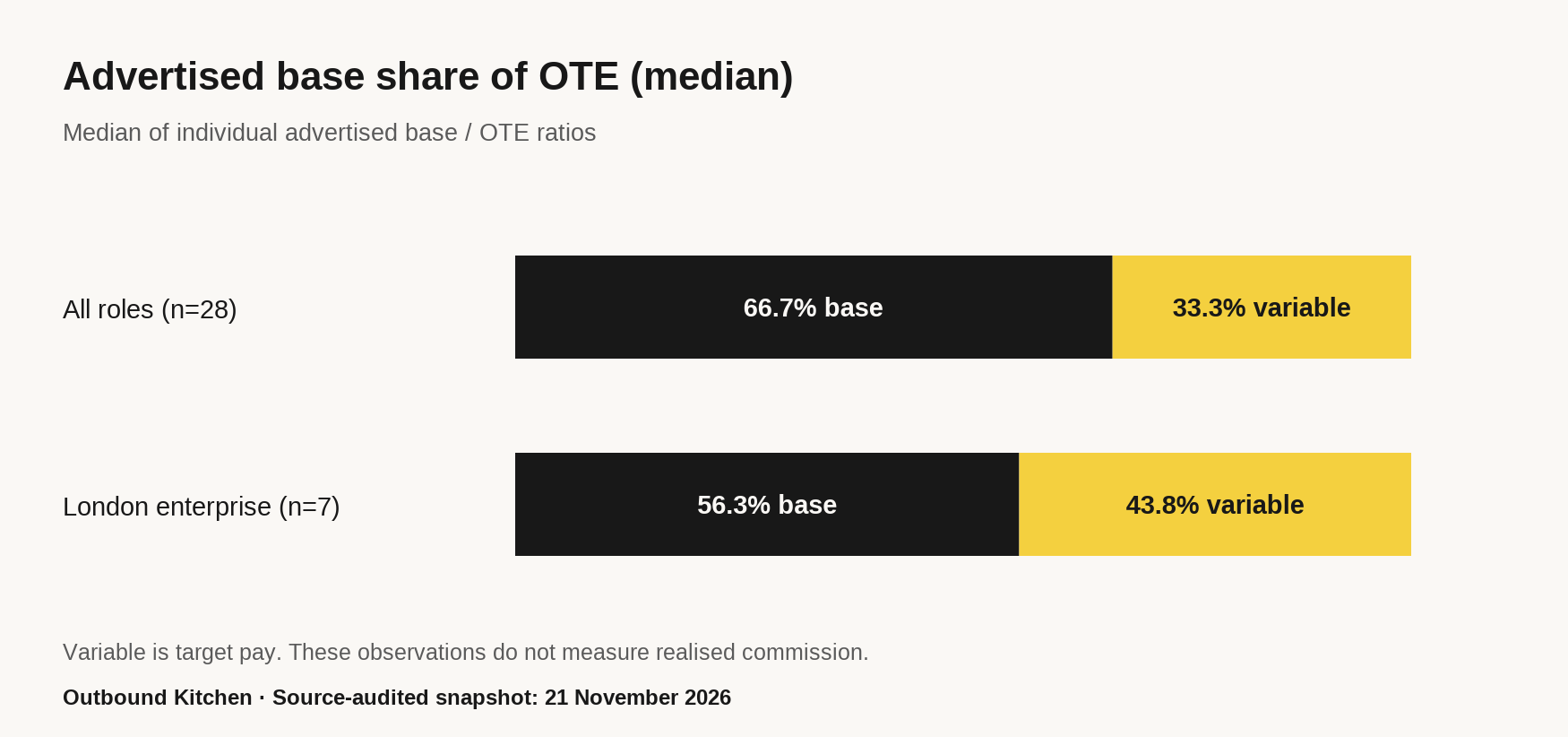
What is the split between base salary and variable pay?
Of the 39 supported postings, 28 disclosed both base salary and OTE. The median base share of OTE was 66.7%, equivalent to a 33.3% target-variable share for that median ratio. Among seven London enterprise listings with both amounts, the median base share was 56.25%. Each figure is the median of individual job-level base/OTE ratios, not a division of the reported median base by median OTE.
The enterprise figure comes from a small sample and should not be read as the standard commission structure for enterprise prospecting. Neither ratio measures what a representative earned or whether the advertised OTE was attainable.
Two hypothetical packages illustrate why OTE alone omits important information:
| Illustrative structure | Annual base | Variable at target | Total OTE |
|---|---|---|---|
| Higher guaranteed component | £55,000 | £20,000 | £75,000 |
| Higher variable component | £45,000 | £30,000 | £75,000 |
Comparing offers also requires the commission trigger, expected ramp period, quota attainment and treatment of accepted opportunities. These fields were not consistently available in the advertisements, so they are not benchmarked in this report.
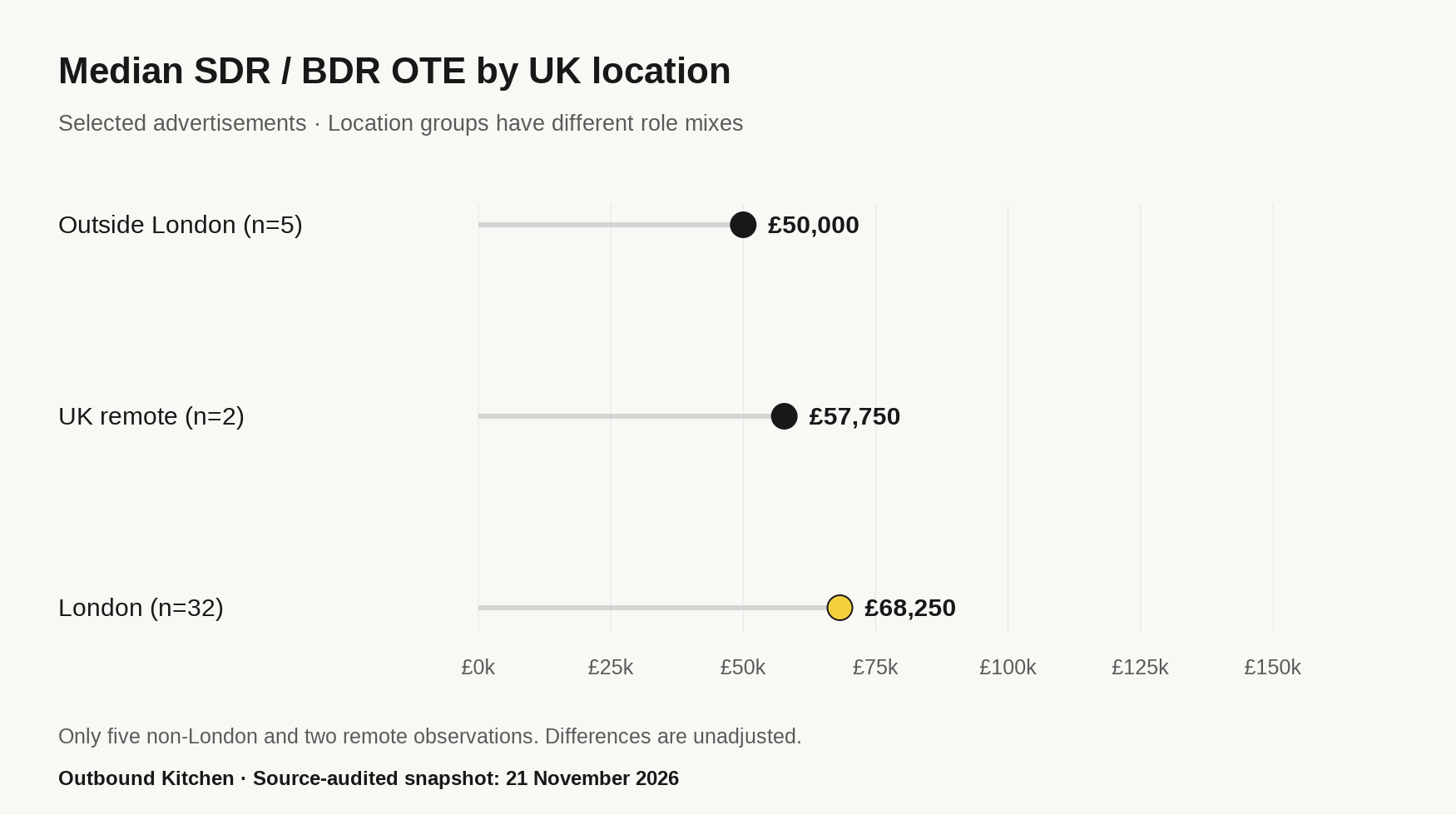
How does advertised pay compare across UK locations?
The London median in our sample was £68,250, versus £50,000 among five jobs with named locations elsewhere in the UK. The two UK-remote-eligible jobs had a median of £57,750.
There are too few observations outside London to estimate city-by-city pay reliably. Nor does the £18,250 difference between the London and named-regional medians establish a geographical premium: the London sample contains more enterprise and technology positions. A like-for-like geographical analysis would need larger samples within comparable roles and industries.
How much should a CRO budget to hire an SDR in 2027?
These salary observations can inform the cash-compensation assumptions in a hiring plan. They cannot establish an SDR’s total employment cost, productive ramp, likely opportunity volume or expected revenue contribution.
For 2027 budgeting, it is useful to separate the market observation (what comparable employers advertise) from the company model (what the hire will cost and produce). The latter depends on recruiting, ramp, payroll obligations, management allocation, opportunity quality and sales-cycle length.
Illustrative first-year hiring model
The following is a worked scenario, not a finding from the job-posting sample:
| Assumption | Amount |
|---|---|
| Annual OTE | £75,000 |
| Assumed employer-cost provision (15% of OTE) | £11,250 |
| Tools and allocated management | £12,000 |
| Recruiting and onboarding | £7,000 |
| Illustrative year-one cost | £105,250 |
| Productive months after ramp | 9 |
| Accepted opportunities per productive month | 5 |
| Nominal pipeline per accepted opportunity | £25,000 |
| Illustrative first-year nominal pipeline | £1,125,000 |
Under these assumptions, the SDR generates 45 sales-accepted opportunities at an estimated cost of £2,339 per opportunity. Nominal pipeline is not recognised revenue, and this calculation is not an ROI estimate. Actual cost and output depend on the employer’s commission payouts, statutory charges, ramp, conversion rates and deal timing.
The editable SDR hiring-budget calculator allows leaders to use their own assumptions alongside the salary observations.
How does the sample compare with other published UK benchmarks?
Meritt’s October 2026 salary analysis and Timberseed’s 2026 London guide provide additional context for base pay, OTE and seniority.
Those publications use different sets of vacancies and sometimes different compensation sources. They are used here as context and were not pooled with the 39 supported observations.
Methodology: how we calculated the advertised salary figures
Job advertisements can close or be removed. Figures describe the advertised compensation observed during the research period, rather than vacancies necessarily open today. The source records distinguish original postings, verified archives and retained historical evidence. Observations without adequate supporting evidence are excluded from the headline statistics.
We reviewed 69 supplied UK or UK-eligible SDR/BDR advertisement records and retained 39 with sufficient source evidence and comparable, bounded annual OTE or target cash compensation. The review excluded 30 records: 23 with missing or conflicting recoverable evidence, six unsupported or insufficiently identifiable records, and one source-supported package whose OTE included pension. Each retained vacancy appears once.
The retained sample comprises 27 primary-source observations (grade A) and 12 dated secondary-source observations (grade B). Secondary job-board evidence is identified in the public data and has not been presented as employer-confirmed evidence. Where a range was advertised, its midpoint was used for the median and mean. For example, £60,000–£80,000 contributes one observation at £70,000. Quartiles use inclusive linear interpolation.
Seniority, account focus and location were classified separately. A senior enterprise role can appear in both subgroup tables while contributing one observation to the overall sample. All 10 retained enterprise-focused roles are in London. Outside-London and remote groups contain only five and two observations, respectively, limiting geographical comparisons.
Listings with base pay alone, unbounded commission, ambiguous target pay or non-comparable compensation were excluded from the headline OTE figures. Base medians and base/OTE ratios use only the 28 retained observations with an explicit base amount. Three captured packages were corrected against specific source evidence: Juicebox, Teya and Tremendous. The audit preserves the originally supplied values and the reasons for those corrections.
Date coverage: 22 of the 39 included observations have independently verified employer or recruiter publication dates between 21 August and 21 November 2026. Twelve additional observations have secondary job-board publication dates in that window; those dates do not establish when the employer first published the role. Four primary posting dates precede the window, and one is unknown. This is a snapshot assembled through 21 November, rather than a strict three-month cohort. Salary disclosure, source availability, London location and technology employers influence which observations appear in this selected sample.
Closed advertisements remain eligible when dated primary or clearly identified secondary evidence supports the recorded salary. Verified archives support three retained roles: HackerOne, AirOps and V7. The LiveKit source supports £98,000–£132,000 OTE on the audit date; the earlier unverified range is recorded only as a sensitivity check, never as a second vacancy. Using that earlier range leaves the overall £65,000 median unchanged.
Source-audit change log, 21 November 2026: The original 69-record handoff was reduced to 39 supported, comparable observations. The UK median changed from £63,000 to £65,000; London changed from £66,500 to £68,250. All tables, charts and public downloads use the revised sample. Expired links alone were not a reason for exclusion. Future corrections should preserve this dated snapshot and identify any changes explicitly.
Download the complete source workbook (XLSX) · Download job-level data (CSV) · Use the hiring-budget model
Related research: San Francisco SDR Salary Benchmark · The full guide to outbound planning